Research release · no new model weights
Guarded MeSH linking for SapBERT
A fixed descriptor lookup augments the unchanged SapBERT ranking for annotated biomedical mentions. Callers supply the mention span and whether it is a chemical or disease.
Research evaluation only. Not a clinical decision system. Managed parity passed on seven prespecified mentions. This static page does not run inference or collect text.
Held-out comparison
The paired 95% bootstrap interval for the document-mean gain was 10.65 to 13.61 percentage points; its one-sided 95% lower bound was 10.35 points. There were 9,643 eligible and 285 excluded mentions.
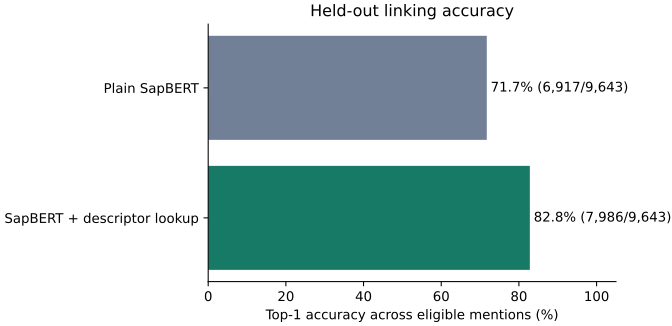
All four declared preservation bounds cleared a −2 point margin. Exact top-ten rankings were preserved for 6,850 protected mentions across 496 documents. This is a held-out comparison within one literature corpus, not an external clinical validation.
How it works
For uppercase abbreviation proxies, defined lexical qualifier phrases, or exact training aliases, the original top-ten list is returned unchanged. Otherwise, a unique exact descriptor match for the supplied type is placed first; ambiguous or missing matches fall back to the original list. The descriptor index is MeSH 2016 and omits supplementary concepts.
The method is not a diagnostic probability or a general entity detector. Patient linkage, pretraining overlap and some related-article dependencies are unknown; 100 test abstracts were selected for similarity to training and development articles. The qualifier proxy is incomplete; its descriptive lower bound was −4.5367 points.
Run and reproduce
Download the files from this Space, obtain the original BC5CDR archive and pinned upstream model separately, and follow the card and local commands. The artificial fixture does not use patient data. The public aggregate results and figure script accompany the measurement code.
Sources
Read the SapBERT paper, BC5CDR corpus paper, and NLM data terms. Courtesy of the U.S. National Library of Medicine. The included terminology index is from 2016 and is not current; NLM does not endorse this project.